
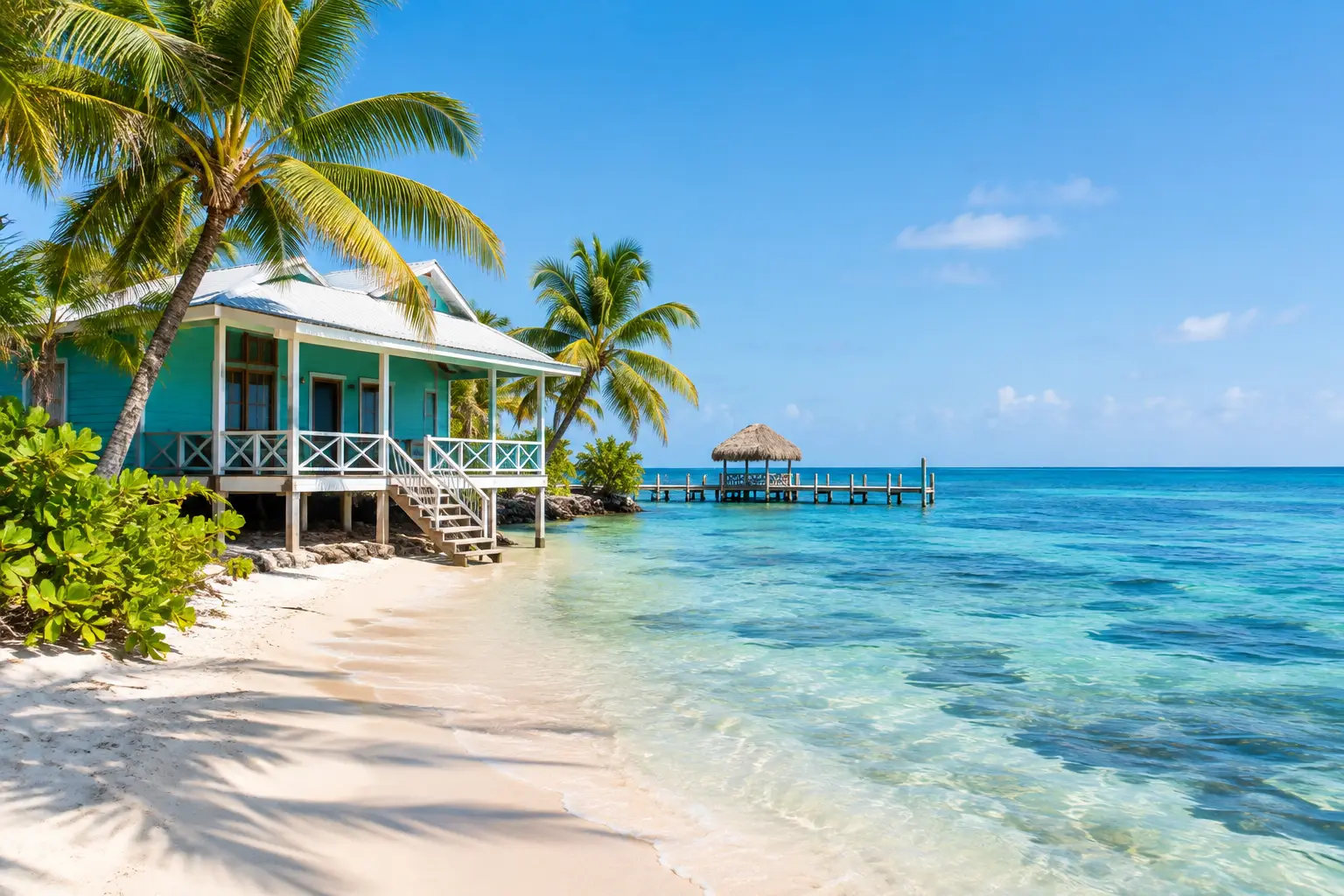
Short answer: Beachfront and waterfront property in Belize is concentrated on Ambergris Caye, Caye Caulker, Placencia and Hopkins, with lower prices generally found on the northern coast around Corozal. Before buying, confirm where your titled boundary ends, because up to 66 feet from the high-water mark can be national land, and mangrove clearing needs a permit.
Why buyers look at waterfront in Belize
Belize’s coast is sheltered by the Belize Barrier Reef, the largest barrier reef in the Northern Hemisphere, which keeps much of the inshore water calm and clear. English is the official language, foreigners can own coastal land outright, and the Belize dollar is fixed to the US dollar. For many buyers, that combination makes a home on the water possible at prices well below comparable property in Florida or much of the Caribbean, though prime beachfront on the main islands is no longer cheap.
Where can you buy beachfront property in Belize?
Short answer: The main beachfront markets are Ambergris Caye and San Pedro, Caye Caulker, the Placencia Peninsula and Hopkins in Stann Creek. Corozal and the northern coast offer waterfront at generally lower prices. Lagoon-front, canal and riverfront property is common too, and is often cheaper than direct Caribbean frontage.
Each area offers a different kind of waterfront:
- Ambergris Caye: Belize’s best-known island market, with condos, villas and lots on the reef side and lagoon side, and the most established rental demand.
- Caye Caulker: a smaller, walkable island with a relaxed rental market.
- Placencia and Hopkins: mainland beaches with road access, villas and resort communities.
- Corozal and the north: bay-front and seafront homes and land, generally less expensive than the cayes and Placencia, according to Belize real estate attorneys Wrobel & Co..
Browse current beachfront listings to compare prices across these areas.
Beachfront, lagoon-front, canal or riverfront?
“Waterfront” in Belize covers several quite different kinds of property, and the price gap between them is large:
- Caribbean beachfront faces the reef and the open sea, usually with a sandy beach, sea breezes and the strongest rental appeal. It also has the most exposure to storms, erosion and sargassum seaweed, and the highest prices.
- Lagoon-front property, common on the west side of Ambergris Caye and on the Placencia Peninsula, faces calmer water and the sunset. It often has mangroves and shallower water, and usually costs much less than reef-side frontage.
- Canal-front lots in planned communities give boat access to the sea or lagoon and can suit buyers who want a dock more than a beach.
- Riverfront property in Cayo, along the Belize River and in the south offers freshwater frontage, usually on larger parcels at far lower prices.
Decide which matters most to you: swimming beach, boat access, rental income or simply a water view. That choice does more to set your budget than the district does. See the best waterfront homes in Belize for examples.
What is the 66-foot reserve in Belize?
Short answer: Under Belize’s National Lands Act, a strip of up to 66 feet from the high-water mark can be kept as national land, even where a parcel appears to run to the water. Building piers, seawalls or structures in that area or on the seabed needs government permission, so check exactly where your titled boundary begins.
The Ministry of Natural Resources explanation of the 66-foot reserve explains how the reserve and use of the seabed are handled. In practice, many older titles run to the high-water mark and many newer surveys show the reserve. A beachfront premium is only worth paying if you know what you actually own. Ask your attorney and a licensed surveyor to confirm:
- whether the title boundary is the high-water mark or a line inland of the reserve;
- whether any existing dock, seawall or palapa has the required permission;
- whether erosion has moved the shoreline since the last survey.
Our guide to evaluating beachfront property in Belize covers the physical checks in more detail.
Do you need a permit to clear mangroves?
Short answer: Yes. Under the Forests (Protection of Mangroves) Regulations, 2018, no one may alter or trim mangroves without a permit from the Belize Forest Department. Alterations over one acre are published in the Gazette, those over 10 acres are reviewed by a ministerial panel, and the department must decide within 60 days.
According to the Belize Forest Department, the factors considered include the distance from protected areas, the impact on nearby coastal and reef areas, the economic benefits of the development, overwash mangroves, alignment with land-use plans, carbon storage and the condition of the mangroves. If a permit is granted, a 4-by-4-foot sign with a waterproof copy of the permit must be posted on site. Many waterfront lots, especially on the lagoon side and in the north, are partly mangrove, so build the permit and its timeline into your plans before you buy.
What is the cheapest beachfront property in Belize?
Short answer: The lowest beachfront and waterfront prices are generally on the northern coast around Corozal, Consejo and Sarteneja, in parts of the south, and on lagoon or canal lots rather than direct Caribbean frontage. Cheaper parcels often come with trade-offs: mangroves, shallow water, no utilities or boat-only access, so price in the work.
Read where to find cheap beachfront property in Belize and check current properties under US$200,000 for waterfront options. When comparing prices, compare the total cost of a usable property: fill, seawall, dock, power, water, road or boat access and permits.
Buying island property
Belize has many small cayes, and some are sold whole as private islands. Island ownership brings the same title rules as the mainland, but higher costs for almost everything else: boat transport for building materials and supplies, independent power and water systems, and longer response times in an emergency. Land tax on cayes uses the beaches and cayes category in the valuation schedule. Read what to know before buying an island in Belize before you make an offer, and see current islands for sale in Belize.
What does it cost to own beachfront in Belize?
Short answer: Holding costs are modest. Land tax on beaches and cayes is 1% of an unimproved value of US$5,000 an acre in most districts, about US$50 a year per acre, and town property tax applies in San Pedro and other towns. Insurance and maintenance usually cost far more than tax.
See our guide to property tax in Belize for how land tax and town property tax work. Belize real estate attorneys Wrobel & Co. report that local insurers, reinsured through North American and European carriers, offer property insurance including hurricane cover at rates from about 1.5% of the insured value for concrete buildings to 2.5% for wooden ones, with storm deductibles typically 5% of the sum insured. Salt air, sun and storms also mean higher upkeep for roofs, metalwork, docks and seawalls.
| Item | Figure | Source |
|---|---|---|
| Stamp duty, foreign buyer | 8% of value above US$10,000 | Stamp Duties (Amendment) Act |
| Land tax, beaches and cayes (most districts) | 1% of US$5,000 per acre = about US$50/acre/year | Ministry of Natural Resources |
| Land tax, beaches and cayes (Toledo) | 1% of US$2,500 per acre = about US$25/acre/year | Ministry of Natural Resources |
| Town property tax cap (unoccupied property) | Up to 2% of value per year | Towns Property Evaluation Act |
| Public reserve from high-water mark | Up to 66 feet | National Lands Act (MNR) |
| Mangrove permit decision time | Within 60 days | Belize Forest Department |
| Property insurance incl. hurricane | About 1.5% (concrete) to 2.5% (wood) of insured value | Wrobel & Co. |
| Typical closing time | 30–90 days | Wrobel & Co. |
Can foreigners buy beachfront property in Belize?
Short answer: Yes. Foreigners have the same ownership rights as Belizean citizens, including on the coast and on islands, and can hold freehold title in their own name. No residency or local partner is needed. The coastal rules that apply, such as the 66-foot reserve and mangrove permits, apply equally to Belizean and foreign owners.
Foreign buyers pay stamp duty of 8% on the value above the first US$10,000, charged on the higher of the price or the assessed value (Stamp Duties (Amendment) Act). Condo buyers should also know that true strata titles exist in registration zones such as San Pedro and Placencia, while elsewhere units are often held through company shares (Belize real estate attorneys Wrobel & Co.). See our Belize property titles guide.
Beachfront buyer’s checklist
- Title opinion from a Belize attorney, plus a current survey that shows the high-water mark and any reserve.
- Permits for existing docks, seawalls and structures, and for any mangrove alteration you plan.
- Water depth, sea grass, sargassum exposure and swimming conditions at different times of year.
- Utilities: Belize Electricity Limited connection, water supply or cistern, septic, internet.
- Access: road condition in the rainy season, or boat access and parking for island property.
- Insurance quotes before you commit, and a hurricane plan. Ambergris Caye was hit by hurricanes in 1942 and 2000, according to Wrobel & Co.
- For rentals: a licence from the Belize Tourism Board and the 9% hotel tax on room revenue.
Waterfront homes for sale in Belize range from simple stilt houses to luxury villas; start with homes for sale in Belize and filter by area. All prices in this guide are in US dollars at the fixed BZ$2 = US$1 rate (Central Bank of Belize).
:%20Buyer’s%20Guide)